Butchers Best Perfectly Roasted Garlicherb Pork Tenderloin
- Achieving the Ultimate Crust: Why This Recipe Works
- Elevating the Classic Roasted Pork Tenderloin Experience
- Essential Pantry Staples for the Herbaceous Crust
- Kitchen Gear Checklist: Must-Have Tools for Success
- Step-by-Step Guide to a Succulent Center
- The Critical 10 Minutes: Resting Your Roasted Pork Tenderloin
- Troubleshooting and Dinner Pairings
- Storage Solutions and Nutritional Snapshot
- Recipe FAQs
- 📝 Recipe Card
Achieving the Ultimate Crust: Why This Recipe Works
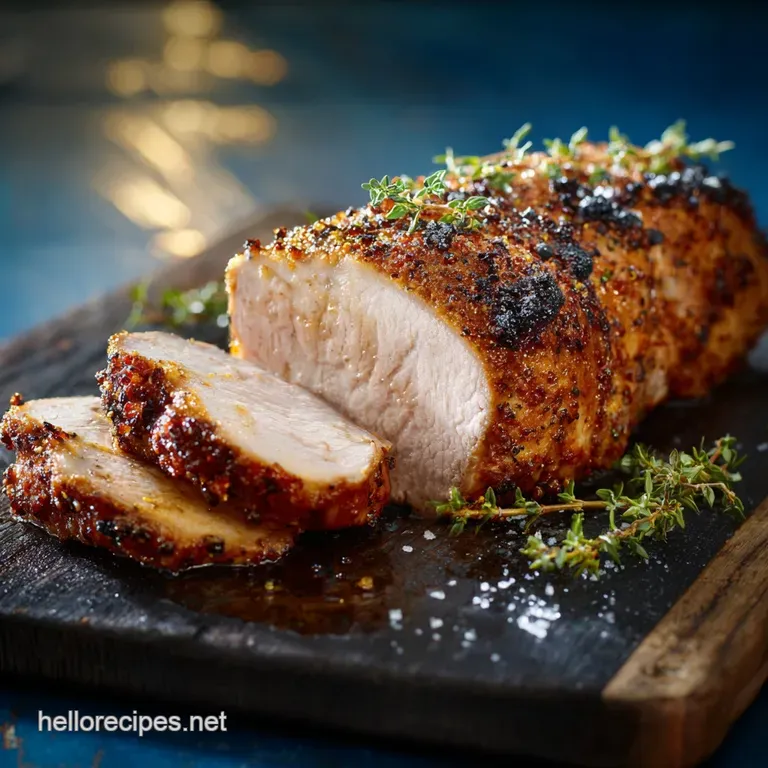
The greatest culinary challenge when preparing a lean cut is ensuring the final result is succulent rather than dry. Our method for this magnificent Roasted Pork Tenderloin eliminates that risk by employing a two-stage cooking process.
Instead of simply relying on extended oven time, we create an aromatic, protective barrier first. By searing the herb crusted meat aggressively on the stovetop, we lock in the natural moisture and activate the intense flavours of the garlic, rosemary, and thyme.
This initial high heat immediately caramelizes the exterior, setting a beautifully crisp, dark crust. Finishing the preparation of the Pork Tenderloin in a hot oven then allows the heat to penetrate gently and evenly to the center, delivering a juicy interior every single time.
This technique is the key to elevating standard Pork Tenderloin Recipes into truly memorable meals.
Elevating the Classic Roasted Pork Tenderloin Experience
We are moving past basic techniques to explore the precise details that transform a good dinner into a great one. Mastering these nuances ensures your Roasted Pork Tenderloin Recipes achieve optimal texture and flavour depth.
Tenderloin vs. Pork Loin: Understanding the Key Difference
The terms pork loin and tenderloin are often mistakenly used interchangeably, but they refer to two very distinct cuts, requiring entirely different cooking strategies. The tenderloin is a long, thin, lean muscle strip (usually 1 to 1.5 lbs), which cooks quickly and is highly susceptible to drying out if overcooked.
Conversely, the pork loin is a much wider, thicker cut, often sold bone-in or boneless, containing more fat, making it suitable for longer roasting times. When cooking a delicate cut like the Pork Tenderloin, you must rely on rapid, high heat methods combined with accurate temperature monitoring to guarantee success.
The Maillard Reaction: Sealing in Juices Before the Roast
The foundation of flavour in this dish is the Maillard Reaction, the chemical process responsible for the browning and creation of thousands of complex flavour compounds. By searing the herb coated pork on all sides prior to placing the roasted pork tenderloin in oven , we initiate this crucial browning.
This step provides the deep, savoury depth that simple baking cannot achieve alone, simultaneously creating a protective shell that minimizes moisture loss during the final roasting phase.
Butcher Prep: Trimming Silver Skin for Optimal Texture
One step often overlooked in Pork Tenderloin Recipes is proper trimming. Silver skin is a tough, silvery membrane of connective tissue found along one side of the tenderloin.
Unlike fat, it will not render down during cooking; it simply tightens and contracts, causing the meat to curl up and become chewy. Using a sharp knife, you must carefully slide the blade just underneath this membrane, pulling gently to slice it away completely before applying the rub.
Flavor Profile Breakdown: Garlicky, Herbal, and Robust
The distinct, robust flavour profile is built on the combination of fresh rosemary and thyme. Rosemary offers an intensely piney, earthy note, while thyme contributes a slightly floral, citrusy background.
This herbal combination is amplified by fresh garlic and coarse salt, creating a dynamic crust that balances the mild flavour of the lean Pork Tenderloin . A touch of smoked paprika adds beautiful colour and a subtle wood fired depth, enriching the final appearance of the Baked Pork Tenderloin .
Essential Pantry Staples for the Herbaceous Crust
To achieve the signature herbaceous crust, the quality and preparation of the rub ingredients are paramount. The structure of the crust relies on forming a thick, adhesive paste rather than a loose dry rub.
We start with three tablespoons of high-quality olive oil, which acts as a binder, ensuring the coarse Kosher salt, freshly ground black pepper, and finely minced garlic adhere firmly to the tenderloin.
The generous amounts of chopped fresh rosemary and thyme are suspended in this oil-garlic blend, ready to infuse the meat during the 30-minute resting period and later crisp up beautifully during the searing process.
Kitchen Gear Checklist: Must Have Tools for Success
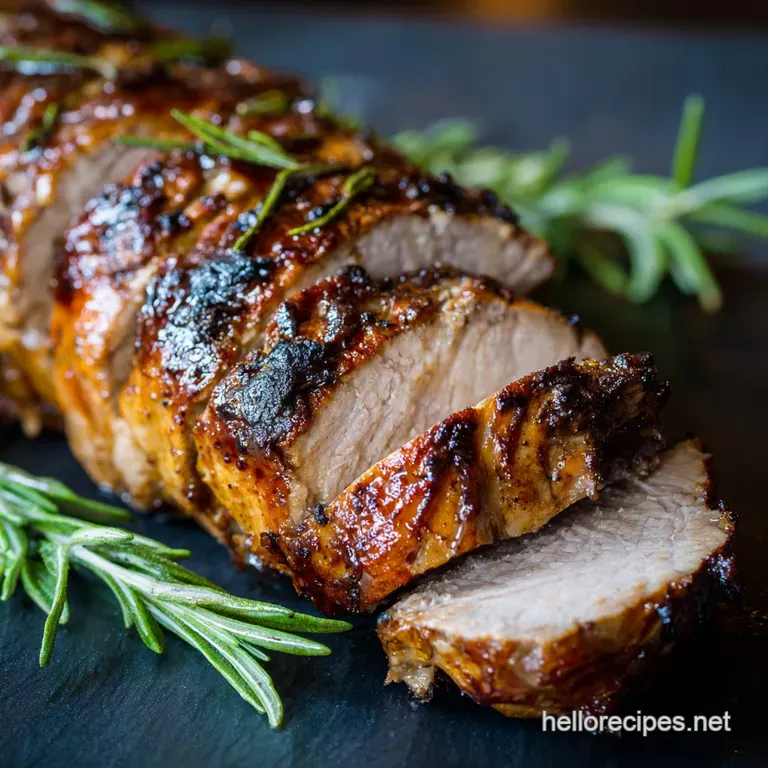
Successful cooking is often determined by the tools we use. For this recipe, the right equipment facilitates precision and heat management, guaranteeing perfect results for your Roasted Pork Tenderloin .
The most critical piece is a heavy bottomed, oven safe pan, like cast iron or heavy stainless steel, essential for the high heat searing stage before the meat moves into the oven.
Building the Perfect Rub: Fresh Herbs vs. Dried Alternatives
While dried herbs are convenient, they lack the volatile oils and moisture content necessary to create a vibrant, textured crust. We strongly advocate for using fresh rosemary and thyme leaves, finely chopped, as directed.
If you must substitute, remember that dried herbs are more concentrated; only use about one teaspoon of each dried variety to avoid an overwhelming or dusty flavour profile on your Pork Tenderloin .
The Best Oil for High Heat Searing (And Why It Matters)
Choosing the correct oil for searing is non-negotiable. Standard olive oil has a low smoke point and will burn and turn bitter when subjected to the intense heat required to create the deep brown Maillard crust.
Instead, use a high smoke point oil such as canola, vegetable, or peanut oil for the searing step. This ensures the oil remains stable as the pan reaches shimmering hot temperatures, allowing the pork to brown without the rub scorching.
The Precision Advantage: Why a Meat Thermometer is Non-Negotiable
Because the Pork Tenderloin is so lean, there is zero margin for error. Overcooking it by just a few degrees will transform it from moist and tender to dry and stringy. An instant read meat thermometer is not optional; it is the single most critical tool for achieving the optimal Pork Tenderloin Temperature .
Trusting the clock or guessing based on colour will almost certainly lead to disappointment.
Prep in Advance: Making the Herb Paste Ahead of Time
One excellent time saving tip is preparing the garlic herb paste (olive oil, herbs, seasoning) a day in advance. Store the mixture covered in the refrigerator. Before using, simply allow the paste to come to room temperature, stir it well, and rub it onto the trimmed tenderloin thirty minutes before cooking.
Related Recipes Worth Trying
- Ultimate Mediterranean Roasted Vegetable Salad with Feta Zesty Vinaigrette — Ditch the sad salads This hearty Roasted Vegetable Salad delivers deep caramelisation and serious flavour Tossed with a bright LemonHoney Vinaigrette its a...
- HoneyGlazed Roasted Carrots with Candied Pecans and Goat Cheese — An absolute cracker These HoneyGlazed Roasted Carrots with Candied Pecans and Goat Cheese are the perfect sophisticated side dish Sweet earthy and...
- Foolproof Pulled Pork Recipe Low Slow Oven Method for Melting Tenderness — Right lets get cracking This slowcooked Pulled Pork recipe uses the oven for a deep smoky bark and melting tenderness A handsoff foolproof method thats ace...
step-by-step Guide to a Succulent Center
Achieving a succulent center is all about managing heat transition. We start by ensuring the trimmed and dry pork tenderloin is coated uniformly with the robust garlic herb rub. The meat must then be allowed to rest at room temperature for at least 30 minutes; this allows the seasoning to penetrate slightly and, critically, ensures the meat cooks evenly throughout when it hits the heat.
Following the room temp rest, the tenderloins are aggressively seared in a screaming hot pan for 2– 3 minutes per side until a deep crust develops. The final cooking step involves transferring the pan directly into the 400° F ( 200° C) oven, where the rapid, high heat environment quickly brings the interior up to temperature while preserving the moisture sealed beneath the crust.
The Critical 10 Minutes: Resting Your Roasted Pork Tenderloin
The resting period is arguably the most important stage of preparing a perfectly cooked Roasted Pork Tenderloin . Directly after removing the meat from the oven, transferring it to a cutting board and loosely tenting it with foil allows the internal temperature to stabilize and the muscle fibers to relax, redistributing the precious internal juices.
Skipping this 10-minute rest guarantees a loss of moisture onto the cutting board instead of into your mouth.
Step 1: Uniform Seasoning and Temperature Acclimation
Ensure the thick herb paste covers every millimeter of the Pork Tenderloin for uniform flavour and crust formation. The pre-searing rest at room temperature (30– 60 minutes) is crucial.
Cold meat hits the pan and drops the temperature dramatically, hindering the sear; On top of that,, starting cold results in a large temperature gradient, meaning the outer edges will inevitably overcook before the center reaches its target Pork Tenderloin Temperature .
Step 2: Sear Aggressively for Maximum Flavour Depth
Use the high smoke-point oil and ensure the oven safe pan is smoking hot. Place the tenderloins in carefully and use tongs to turn them every few minutes, searing all four sides until they boast a deep mahogany crust.
This process, which takes only 6– 10 minutes total, establishes the structural and flavour basis of the final dish before it becomes a Baked Pork Tenderloin .
Step 3: Oven Roasting Until Ideal Internal Temperature
After searing, the whole assembly moves into the preheated oven for the final stage. The roasting time is generally short, about 15– 20 minutes, depending on the thickness of your specific tenderloin pieces. This controlled heat finishes the cooking without burning the external crust.
How to Check for Doneness: Safe Temperatures Explained
Precision here is vital. Insert your instant read thermometer into the thickest part of the tenderloin, avoiding touching the pan or any bone (which isn't usually present in this cut).
You must remove the
Roasted Pork Tenderloin
from the oven precisely when the internal temperature reaches $140^{circ}text{F}$ ($60^{circ}
text{C}$).
During the ensuing 10-minute rest, a phenomenon called carryover cooking will occur, naturally raising the temperature by an additional 5 to 10 degrees, resulting in a final, perfectly safe, and incredibly juicy internal temperature of $145^{circ}text{F}$ ($63^{circ}
text{C}$).
Slicing Against the Grain: Maximizing Tenderness
Once rested, examine the meat to identify the direction of the muscle fibers (the grain). To achieve maximum tenderness, slice the Pork Tenderloin perpendicular to these lines into 1/2 inch thick medallions. This shortens the fibers, ensuring the final texture is melt-in-your mouth soft.
Drizzle with any accumulated pan juices from the resting board for added moisture and flavour.
Troubleshooting and Dinner Pairings
Avoiding Dryness: Common Mistakes to Prevent
The primary cause of dry pork is either ignoring the meat thermometer or skipping the post oven rest. If you are starting with good quality meat and following the searing technique, dryness is almost always a result of overcooking past $140^{circ}text{F}$ ($60^{circ}
text{C}$) or slicing too early.
Another common mistake is failing to pat the tenderloin completely dry before seasoning, which prevents the proper searing and crust formation.
Quick Side Dish Ideas to Complement the Herbs
To turn this into a full meal, pair the savory Roasted Pork Tenderloin with simple, comforting sides. Classic choices include creamy mashed potatoes or, for a more rustic feel, oven roasting the pork alongside other vegetables.
Try serving roasted pork tenderloin with potatoes and carrots tossed in olive oil and rosemary for a delicious sheet pan meal approach. For lighter fare, simple blanched green beans tossed with lemon zest and almonds complement the robust herbs beautifully, creating a well rounded plate of roasted pork tenderloin with vegetables .
Recipe Variations: Swapping Spices and Marinades
While the garlic herb crust is classic, the technique is versatile. For a seasonal twist, try creating roasted pork tenderloin with apples by placing thinly sliced apples and onions in the roasting pan with the pork, seasoning the rub with cinnamon and sage, and finishing with a drizzle of maple syrup.
For a bold flavour change, swap the European herbs for a smoky, spicy Tex-Mex rub incorporating chili powder, cumin, brown sugar, and cayenne.
Storage Solutions and Nutritional Snapshot
How to Safely Store and Reheat Leftover Pork
Store any leftover Pork Tenderloin immediately after cooling (within two hours of cooking). Slice the remaining meat before storage, placing it in an airtight container in the refrigerator, where it will keep safely for 3 to 4 days.
When reheating, avoid high heat, which will quickly dry out the already lean meat. Instead, place the slices in an oven safe dish with a tablespoon of chicken broth, cover tightly with foil, and warm slowly in a $300^{circ}text{F}$ ($150^{circ}
text{C}$) oven until just heated through.
Calorie Count and Macro Breakdown
This lean cut makes the Baked Pork Tenderloin an excellent choice for health conscious diners. Based on an estimated four ounce serving, the meal delivers approximately 250 to 280 calories.
It is incredibly high in protein, providing around 30 to 35 grams, with a moderate fat content (12 to 15 grams, largely unsaturated from the olive oil). The high protein content and minimal carbohydrates make the Pork Tenderloin a satisfying and nutritious cornerstone for any balanced diet.

Recipe FAQs
How do I ensure my pork tenderloin isn't dry as a bone?
The secret is the thermometer, mate! Pork tenderloin is cooked perfectly when it reaches a final temperature of 145°F (63°C). You must pull it out of the oven early, at 140°F (60°C), and let it sit for 10 minutes.
That crucial resting time allows carryover cooking to finish the job and locks all those lovely juices inside resulting in beautifully succulent meat every time, not chewy tragedy.
What exactly is ‘silver skin’ and do I really need to bother trimming it off the Roasted Pork Tenderloin?
Ah, the silver skin! It's that thin, silvery, tough membrane you often see on the surface of lean cuts. Unlike fat, it won't melt during cooking; instead, it contracts, making the meat tough, chewy, and misshapen.
Grab a sharp knife, slide it beneath the skin, and carefully slice it off it’s definitely worth the minor faff to ensure your Roasted Pork Tenderloin cooks and eats like a dream.
I’m in a rush can I skip the searing step and just roast it straight away?
You can, but skipping the sear is a bit like cancelling Christmas lunch! Searing creates that beautiful, dark, flavourful crust (the Maillard reaction) that is crucial for texture and depth of flavour in this recipe.
If time is genuinely tight, ensure your oven is cranked up and piping hot for the first five minutes to encourage better browning, but for the best result, the pan-sear is non-negotiable.
I’ve got leftover pork what’s the best way to keep it fresh and reheat it?
Leftovers are gold! Store sliced pork tightly sealed in the fridge for up to four days. As it’s such a lean cut, reheating can be tricky without drying it out.
We recommend slicing the pork first, then gently warming the slices in a small saucepan with a splash of chicken broth or gravy, or you can microwave them briefly covered with a damp paper towel.
I need a bit of inspiration what side dishes go splendidly with this herb roasted pork?
This garlic herb pork is brilliant with classic, comforting pairings. Think proper crispy ‘roasties’ (roast potatoes) or creamy mashed potatoes drizzled with any pan juices.
For greens, a simple, vibrant vegetable like asparagus or green beans tossed in lemon zest provides a perfect counterpoint to the richness of the herbs. A light apple or cider gravy is also a marvellous traditional accompaniment.
Perfect Herb Roasted Pork Tenderloin
Ingredients:
Instructions:
Nutrition Facts:
| Calories | 1122 kcal |
|---|---|
| Protein | 15.2 g |
| Fat | 35.2 g |
| Carbs | 57.1 g |
| Fiber | 30.5 g |
| Sodium | 9910 mg |
